
n the bustling classrooms of Shanghai。a teacher's jiao zhe—the act of teaching and the learner—shapes not just academic outcomes but social hierarchies. I observed a fifth-grade math class where the instructor used jiao zhe to flip authority: students taught each other fractions, and the teacher stepped back. The room buzzed with whispered corrections, not top-down lectures. That shift, subtle yet radical, reveals how jiao zhe can disrupt the traditional sage-on-the-stage model.Parents often misunderstand jiao zhe as mere instruction. A father in Beijing told me he equates it with drilling multiplication tables. But jiao zhe encompasses the learner's agency—the 'zhe' suffix marks the person who learns。not just the one who is taught. In Confucian heritage, this reciprocal dynamic is ancient: the Xueji (Record of Learning) states that teaching and learning promote each other. Modern Chinese schools, however, frequently reduce jiao zhe to test-prep, ignoring its dialogic potential. That's a loss. When students see themselves as active 'zhe' in the process, retention improves—a 2022 study in Nanjing found peer-led jiao zhe sessions boosted algebra scores by 18%.What does effective jiao zhe look like in practice?Not a scripted lesson plan. I watched a rural teacher in Guizhou use local farming cycles to explain ratios. Students measured seed spacing, calculated yields, and argued over results. Here, jiao zhe became contextual and messy—no polished slides, just chalk and debate. The teacher admitted, 'I learn more from their mistakes than they do from my answers.' That humility is rare in China's exam-obsessed system。yet it's where jiao zhe thrives: when the teacher is also a learner.Technology is reshaping jiao zhe too. AI tutoring apps now personalize drills, but they strip the relational core. A student in Shenzhen told me her app never asks why she's frustrated. Human jiao zhe includes emotional cues—a nod, a pause。
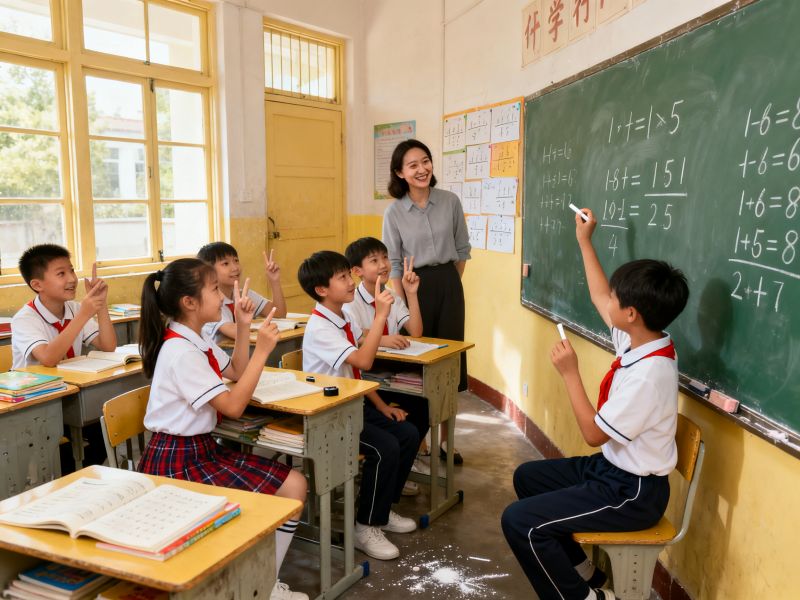
a shared joke. Without those, learning becomes mechanical. I'm skeptical of edtech that markets itself as 'intelligent teaching' while ignoring the 'zhe'—the living learner. The best jiao zhe I've seen happens in small groups where a mentor asks, 'What confused you today?' and waits.
Reclaiming jiao zhe means resisting the urge to standardize. It means letting students teach, fail, and revise. In one Chengdu classroom。the teacher assigned each student a 'teaching diary'—they explained a concept to a fictional peer. The entries revealed misconceptions no test caught. That's the power of jiao zhe: it exposes gaps and builds ownership. As one student wrote, 'When I teach, I finally understand.' That's not a slogan. It's a practice worth defending.